VFlood-RRI
VFlood-RRI is a Python (NumPy/Numba) reimplementation of the RRI (Rainfall-Runoff-Inundation) model (opens in a new tab) developed by Sayama et al. (2012) — a distributed flood model that simulates slope runoff, river routing, and two-dimensional inundation together on a single grid.
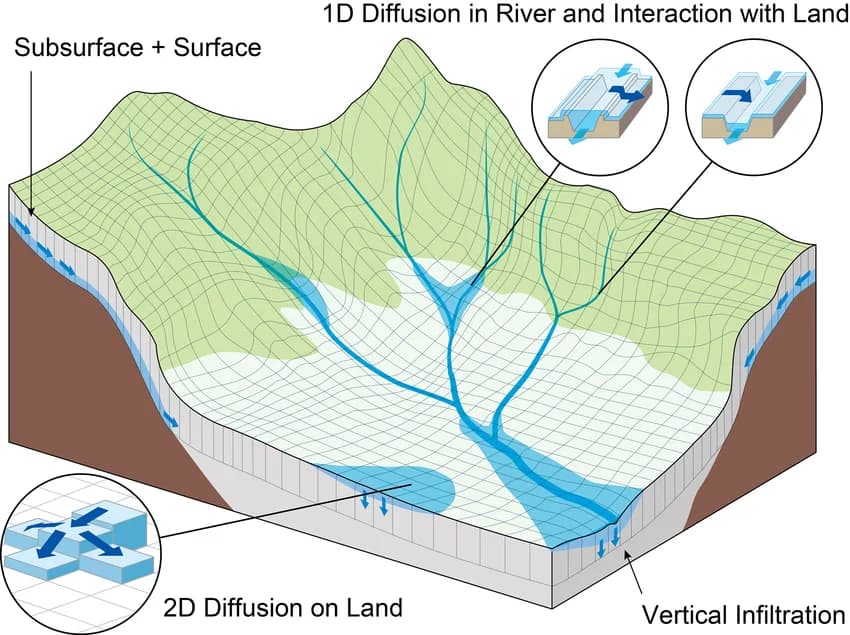
Schematic diagram of the original RRI model — Sayama et al. (2012). VFlood-RRI replicates the same physics (slope runoff, river routing, 2D inundation) as a Python library.
The model itself has no GUI, same as the original RRI distribution (you run an .exe
against a config file in the same folder) — VFlood-RRI follows the same pattern, except
you invoke a Python command instead of an .exe, and RRI_Input.txt is still the one
plain config file everything reads. This documentation covers that file-and-command-line
path in full.
But you don't have to work at that level by hand. Two optional desktop GUIs sit on top of the exact same library code — VFloodPrep turns raw DEM/rainfall/land-cover sources into a ready-to-run project, and VFloodControl checks that project for the kind of mistakes that otherwise only surface mid-run, runs it with a live log, and hands off to export/post-processing once output is ready. See Acquiring Input Data §4e-4f.